

Nutrition plays a central role in supporting both mother and child during this period, and dates have been eaten by expectant mothers in many cultures for centuries. They carry fibre, minerals, some vitamins, and a lot of natural sugar. A handful of clinical studies have also looked at whether eating dates in late pregnancy changes how labour goes. The results are encouraging, but the studies are small and not strong, so this article sets out what they actually found. In Malaysia, Medjool and Deglet Noor are easy to buy by the kilo from a Kurma supplier.
This article is general information, not medical advice. Every pregnancy is different, so talk to your doctor or midwife before changing your diet, especially if you have gestational diabetes or have been told to watch your sugar intake.
What is in a date
Dates are often referred to as “nature’s candy,” but unlike refined sugar, their sweetness comes with fibre and minerals. Per 100 g, Medjool dates have about 277 kcal, 66 g of sugar and 6.7 g of fibre, according to USDA FoodData Central. That makes them a dense source of energy. The fibre matters too: the NHS notes that constipation is common in pregnancy and after birth, and more fibre in the diet is one of the first things it suggests.
Kurma Medjool
kurma medjool is a large, soft date with a caramel-like flavour. Most Medjool sold in Malaysia comes from Palestine or Jordan. The same USDA entry lists 696 mg potassium, 54 mg magnesium and 0.9 mg iron per 100 g of Medjool. Potassium and magnesium are useful amounts. The iron is small, so dates do not replace any iron supplement your doctor has prescribed. If you want to know more about where these dates come from, our piece on Kurma Medjool from Palestine covers the variety itself.
What the labour studies found
This is where most of the interest comes from. In a 2011 study in Jordan, Al-Kuran and colleagues followed 69 women who ate six dates a day for the four weeks before their due date and compared them with 45 women who ate none. The date group arrived at hospital more dilated (3.52 cm vs 2.02 cm), went into labour on its own more often (96% vs 79%), needed prostin or oxytocin less often (28% vs 47%), and had a shorter latent phase of the first stage of labour. It was not a randomised trial, and the authors said a randomised trial was needed.
A larger 2024 systematic review and meta-analysis pooled 48 studies. Eating dates in late pregnancy was linked to shorter labour (except the second stage), less need for induction and more spontaneous vaginal births. The reviewers also rated the overall quality of the evidence as unacceptable, with a high risk of bias in most studies, and safety was recorded in only four trials. So the honest reading is: promising, not proven.

Eating dates day to day
Dates keep well in a closed container in the fridge, so they are an easy food to have on hand when regular meals slip.
Kurma tangkai: dates on the stem
kurma tangkai is not a separate variety. It means dates sold still attached to the stem, and in Malaysia that is almost always Deglet Noor from Tunisia or Algeria, a semi-dry, firmer date than Medjool. Like other dates it has some calcium and a little zinc (Medjool, for comparison, has 64 mg calcium and 0.44 mg zinc per 100 g), but it is not a main source of either. The stem is about presentation; it does not change the nutrition.

How many to eat
One of the simplest ways to use dates during pregnancy is to consume them as daily snacks. Six dates a day was the amount used in the Jordan study. Pairing dates with milk, yogurt, or nuts gives a more balanced snack than dates alone. Because they are high in sugar and calories, portions matter; our article on dates for healthy weight gain shows how quickly they add up.
Dates at family gatherings
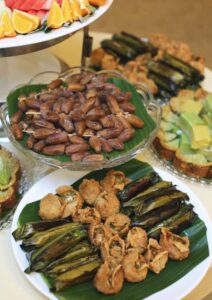
In many Malaysian homes a plate of dates comes out for buka puasa in Ramadan, at weddings and whenever guests visit. A pregnant woman will be offered them often, so it helps to keep a rough count of how many you have eaten in a day.
Other common questions
Mood and cramps
Pregnancy can bring mood swings, tiredness and cramps. Dates contain a little vitamin B6 (about 0.25 mg per 100 g of Medjool) and some magnesium. That is nutrition, not a treatment, and there is no good evidence that dates themselves settle mood or cramps.
Eating dates during labour
Dates are mostly natural sugar, so a few give quick energy. Some trials in the 2024 review gave women dates during labour itself, and pooled results showed shorter labour, again from studies the reviewers judged low in quality. Whether you can eat during labour is a question for your hospital team.
Dates after the birth
The same review looked at dates eaten after birth. It reported more breast milk and less bleeding after delivery in women who ate dates, but with the same weak evidence behind it. Treat that as a reason to keep dates in a varied postpartum diet, not as a replacement for medical care.
Dates in other food cultures
In Arab countries dates are the usual food for breaking the fast. In Iranian homes they are often served with tea. In Malaysia most households buy them in bulk before Ramadan and Hari Raya. None of these traditions is evidence about pregnancy; they simply explain why dates turn up so often on the table.

Conclusion
Dates are a nutritious, energy-dense food that fits well into a pregnancy diet in sensible amounts. The studies on late-pregnancy dates and labour point in a hopeful direction, but they are small and mostly weak, so no one can promise an easier birth from eating them. If you want to try them, Medjool is the large soft one; kurma tangkai is usually Deglet Noor, firmer and smaller, so you eat more of them for the same weight. Either works as a snack if you keep count.
References
- Al-Kuran O, Al-Mehaisen L, Bawadi H, Beitawi S, Amarin Z. The effect of late pregnancy consumption of date fruit on labour and delivery. J Obstet Gynaecol. 2011;31(1):29-31. doi:10.3109/01443615.2010.522267 (PMID 21280989)
- Salajegheh Z, Nasiri M, Imanipour M, et al. Is oral consumption of dates (Phoenix dactylifera L. fruit) in the peripartum period effective and safe integrative care to facilitate childbirth and improve perinatal outcomes: a comprehensive revised systematic review and dose-response meta-analysis. BMC Pregnancy Childbirth. 2024;24(1):12. doi:10.1186/s12884-023-06196-y (PMID 38166785)
- U.S. Department of Agriculture, FoodData Central. Dates, medjool (SR Legacy, FDC ID 168191). fdc.nal.usda.gov
- NHS. Constipation. nhs.uk/conditions/constipation